

Zoom Phone Setup for SMB Admins
Designed a centralized setup experience that guided administrators through deployment with clear tasks and progress tracking.
Project Overview
Timeline: 2021–2022
Platform: Web Admin Portal
Users: SMB Administrators
Role: Product Designer
Team: PM · Engineering · Research · Design
Impact
~40% ↓
Setup time
85% → ~45%
SMB admins requiring assistance
~2 hrs → ~1 hr/day
Support time spent assisting SMB admins
What is Zoom Phone?
Zoom Phone is a cloud-based business communication system on the Zoom platform.
Zoom Phone now serves over 10 million seats worldwide. 17% of them are Small Business (SMB) Users.


Who are the users?
The SMB (Small Business) admins are the primary users. SMB Admins who purchase phone plans need to assign these plans to their employees.
Research


User Pain Points
01 — Admins had to jump between multiple pages to complete setup.
02 — The complex setup process was difficult to navigate and complete.
03 — Admins struggled to understand what to do next and track their progress.
The existing setup was fragmented across multiple sections, with no clear step-by-step guidance.

Add users?
User management
No Setup Guide

Phone system management
Add users?
Design goals
-
Help more SMB admins set up their phone plans by themselves
-
Reduce Zoom support time
Key Solutions
1. Bringing fragmented setup into one place
Before Setup Guide, administrators needed to switch between different sections of the admin portal to activate services, invite users, assign licenses, and configure phone settings. I brought these tasks into a centralized setup experience so admins could complete and track setup in one place.

2. Breaking complex setup into manageable steps
The Zoom Phone setup process involved many interconnected flows and dependencies. I mapped the end-to-end experience to structure the setup into clear, manageable steps and establish a logical sequence.

3. Making progress and next steps clear
I organized setup tasks into clear categories, surfaced progress and completion states, and prioritized essential steps before advanced configuration. This helped administrators understand what to do next without navigating the full complexity of the phone system at once.
Task grouping
Progress visibility
Guided actions

Design Process
1. Research
Communicating with the Research Team and Content Designer
Understand the unique onboarding needs for Zoom Phone Admins in the SMB space. As well as help address the current gap in the onboarding experience.
2. User scenario
Narrative for "Welcome page"
As an admin, after I purchase phone plans for my company, I am taken to a new page called “Guided setup”. The guided setup page has a friendly welcome message that makes me feel my purchase is appreciated. The page informs me of what I need to do to get my phone system working. It also lets me know what is required of me in terms of time, documents, etc. I can start the setup process at that time or come back to it later. There is also easy access to support if I need it.
The story can also be used for testing.
Compare a design solution against the requirements

Design requirements
a. Welcome message, including the name of the feature
b. Some delights (image, animation, etc.)
c. Thank you message
d. Overview of the steps that are needed to complete
e. Estimated time commitment
f. CTA to start the process
g. Link to support
Using this Setup Guide for all kinds of Zoom products in the future
As a design owner, I expand my design scope to help more users and achieve more business goals. All Small Business (SMB) Zoom users will use this Setup Guide. It will positively impact products such as Zoom Meeting, Zoom Apps, Zoom Chat, Zoom Marketplace, etc.
Setup Guide for:
Zoom Meeting, Zoom Apps, Zoom Chat, Zoom Marketplace, etc.
3. Wireframes & sketches
Consolidate all admin jobs-to-be-done into a centralized page in the web portal and build a framework that will support the admin onboarding of Zoom Phone.
Version 1 - Cards
I used cards to organize all the steps for users to follow.

Engineering feedback changed the direction
I showed this low-fidelity design to the engineers for discussion to make sure there were no technical issues in their development process. Their feedback surprised me. I got two important pieces of information from them:
1. The onboarding process must be orderly.
2. The user must complete one step before starting the next step.
Version 2 - Rows
After communicating with the engineering team and the phone hardware team to get more details. I created version 2 that meets more user needs.
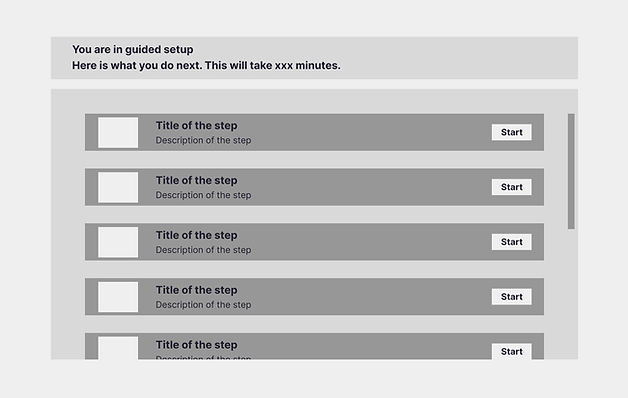
Validate that the design is meeting requirements

Design requirements
a. Title, reminding the user of a section name and purpose
b. List of all current guided setup steps available
c. The step itself. This can be "Start", "In progress" or "Completed" state
d. Icon or image for the step
e. Title of the step
f. Description of the step, purpose
g. CTA
h. Scroll bar, if necessary
Version 1
Version 2
Version 2
Translating the Solution into Design System Components
Built reusable components for task rows, status states, actions, and navigation, creating a consistent framework that could scale across the setup experience.


“Landing Page” States
Designed clear task states to guide admins through the setup process and make progress immediately visible.
Start
The first required task is highlighted, giving admins a clear starting point while upcoming tasks remain disabled.

In progress / completed
Completed and in-progress states provide clear feedback and help admins quickly understand what’s done and what to do next.

Creating reusable templates for Zoom Setup
Designed three reusable templates to provide a consistent structure for different setup workflows.


Designed a new Step Indicator for design system
In the Zoom Design System, we only have one horizontal step indicator, and it doesn’t work for this feature :(
Before:

After:

4. Mockups - Key screens - Demo
These three key screens capture the core setup journey: getting started, tracking progress, and completing tasks. Together, they show the end-to-end experience without unnecessary repetition.
Adding a purchase CTA for users during the Setup Phone process
During the Assign Zoom Phone process, users may need to purchase more phone numbers for their employees. Can I add a purchase CTA for users during that process? This would also be good for our business.
After discussing this with the Zoom Monetization team, they allowed me to add a CTA to go directly to the buyer and pricing page. We will add this feature soon.
Improvement
Consolidating a fragmented setup flow into one guided experience with clear task organization and progress visibility.
Before - 1:
Admins had to jump across multiple pages.

User Management
Phone System Management
No Setup Guide
Account Management
After - 1:
One guided workflow with clear task organization.

New Setup Guide
Clear task grouping
Before - 2 :
Setup tasks lacked visibility.
After - 2 :
Progress was surfaced through clear status indicators.

Add users
Manage license

Clear progress & status indicators
Before - 3 :
Complex configuration overwhelmed new admins.
After - 3 :
Setup was broken into manageable, guided steps.
Bigger scope in the future
Add users
Manage license
User Management

Guided step-by-step actions
After finishing the "Activate Zoom Phone" flow, the admin unlocked "Invite Users to Zoom". Admins can add users here.
Metrics
Made Zoom Phone setup faster and easier for SMB administrators.

Post-launch metrics based on internal estimates approximately two years after launch.
Reflection
Working closely with engineering and hardware teams gave me a deeper understanding of the technical constraints and device-specific onboarding experiences.
If I had gained this knowledge earlier, I could have made better-informed design decisions sooner, reduced iteration, and moved the project forward more efficiently.

